


A Siliconised Endotracheal Tube is designed with a treated surface that may help it pass smoothly during placement. For buyers, the coating is only one part of the decision. Tube design, patient size, intended route, and clinical setting all matter. Small details matter. Inner diameter affects airflow and equipment compatibility, while outer diameter and length influence fit. Buyers may compare cuffed and uncuffed models, standard and reinforced shafts, or oral and preformed nasal configurations. Some products include features such as a radiopaque line, Murphy eye, or subglottic suction lumen. These options serve different needs; they are not interchangeable upgrades.
A useful comparison starts with the manufacturer’s specifications and instructions for use. Check dimensions, cuff design, connector fit, packaging integrity, and stated material details. Then consider how the tube will be stored, handled, and used by trained clinicians. A smooth surface can be appealing, but it does not guarantee easier placement for every patient. That point deserves attention. Product performance depends on anatomy, technique, and clinical circumstances, not coating alone. Buyers should also verify applicable quality documentation and seek guidance from qualified clinical staff when comparing models. There is no universal best type. This overview introduces the main options and practical selection factors, while recognizing that specifications vary by manufacturer and market. A careful shortlist is more useful than a confident guess.
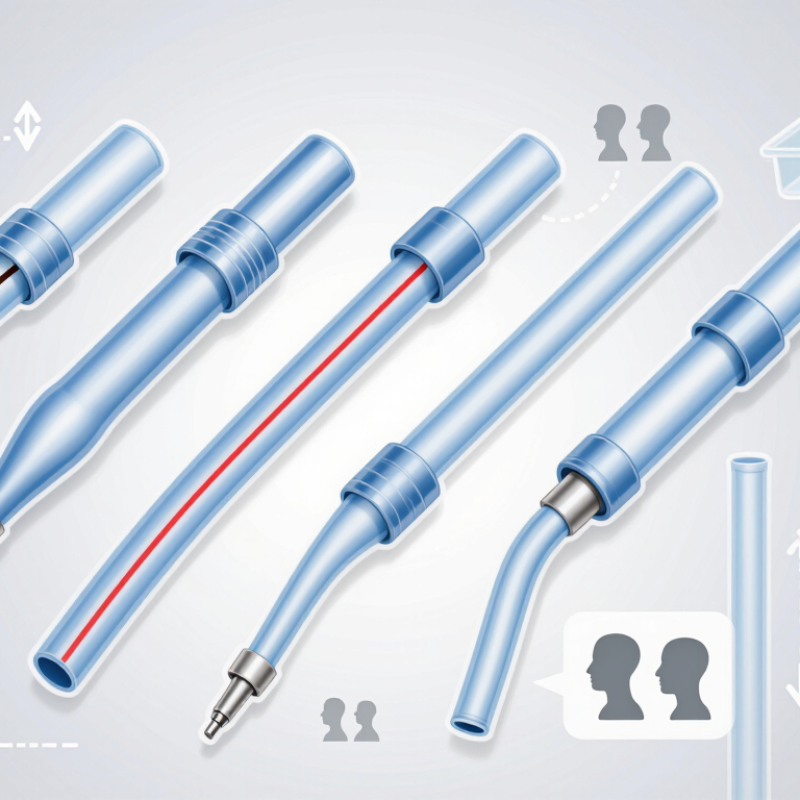
A siliconised endotracheal tube is typically a flexible tube with a silicone-treated surface; the underlying tube may use medical-grade thermoplastic, such as PVC. The treatment can reduce surface friction during handling, but “siliconised” does not describe one universal coating or manufacturing method. Buyers should check the product specification for the base material, coated surface, and stated purpose. Small details matter.
Production generally begins by extruding the tube to its specified diameter and length. Manufacturers add depth markings and a radiopaque line, then attach the cuff, inflation line, and pilot balloon where applicable. A silicone layer may be applied and cured at a defined stage; the exact sequence varies by design. Finished devices undergo checks for dimensions, leaks, connector fit, and coating consistency. A coating that looks smooth is not proof of uniform performance.
ISO 5361:2023 sets requirements and test methods for tracheal tubes and connectors, offering buyers a technical reference when comparing specifications. The American Association for Respiratory Care cites 20–30 cm H₂O as the usual adult endotracheal cuff-pressure range; that clinical figure is useful context, not a substitute for device testing or instructions for use.
Siliconised endotracheal tubes differ not only in surface finish, but also in shape, cuff design, and reinforcement. A smoother surface may reduce friction during passage, though it does not guarantee easier placement in every patient. Small details matter.
Standard tubes suit many routine airway setups. Cuffed versions create a seal when correctly sized and managed; uncuffed designs may be selected in specific clinical situations. Preformed oral or nasal tubes hold a set curve, which can help keep tubing clear of the face or surgical field. Reinforced tubes resist kinking when bending is likely, but their flexibility can make positioning less predictable. A Murphy eye provides an alternate opening near the tip if the main opening is obstructed. Real anatomy varies.
For buyers, compare internal and external diameters, length markings, cuff configuration, connector fit, and the tube’s stated material and surface treatment. These features affect airflow, resistance, and how much room remains for other airway equipment. Check that the chosen design matches the intended patient group and clinical setting. On paper, a smooth tube can look ideal; actual placement depends on anatomy, technique, and trained clinical judgment. Follow the product instructions, and inspect the tube before use.
How tube design affects airway placement and ventilation
The chart compares representative designs: cuffs provide an airway seal for positive-pressure ventilation; reinforced tubes resist kinking; preformed tubes follow a set curve to help route the breathing circuit; and subglottic-suction tubes add a lumen for secretion removal above the cuff. Siliconised finish is a surface treatment, not a separate tube geometry, and availability varies by product. Confirm specifications and clinical suitability with the product labeling and relevant clinical guidance.
2026 Top Siliconised Endotracheal Tube Types for Buyers
Common Siliconised Endotracheal Tube Types and Their Uses
Siliconised endotracheal tubes have a low-friction outer surface that can ease passage through the mouth or nose. Standard cuffed tubes are commonly used for adult ventilation; the inflatable cuff helps limit air leakage and aspiration risk. Clinicians should check cuff pressure with a manometer, not guess by touch. Uncuffed tubes may suit selected paediatric patients, depending on age, airway size, and clinical guidance. Small details matter.
Reinforced tubes contain a flexible spiral that helps resist kinking when the head or neck is positioned sharply. They can be useful in some head-and-neck procedures, but the wire does not prevent every form of compression. Preformed oral or nasal tubes curve away from parts of the surgical field, helping keep the breathing circuit clear. Subglottic-suction models add a channel to remove secretions above the cuff; they are considered when prolonged ventilation is anticipated.
The UK Fourth National Audit Project, NAP4, documented 184 major airway complications across anaesthesia, intensive care, and emergency departments. Its findings underscore careful airway planning, not the superiority of any single tube design. Tube selection still depends on anatomy, procedure, ventilation needs, and clinician judgement. Coating can help insertion. It cannot replace correct sizing, placement checks, or monitoring. Buyers should verify the product’s stated material, cuff design, and intended use; product descriptions can be easy to misread.
2026 Top Siliconised Endotracheal Tube Types for Buyers
Key Features Buyers Should Compare When Selecting a Tube
When comparing siliconised endotracheal tubes, start with the intended clinical setting and required tube type. Cuffed, uncuffed, and reinforced designs serve different needs; confirm suitability with qualified clinical staff. Check the material, coating description, size range, and cuff details against the product documentation. A smooth coating may sound reassuring, but its performance can vary by design. Avoid judging by appearance alone.
Tips: Compare tube markings, connector fit, and visibility under expected imaging conditions. Ask for clear instructions and compatibility details. Small details matter.
Inspect packaging and labeling, including size identification and traceability information. Review flexibility and resistance to kinking where relevant to the procedure. Confirm that the product meets applicable quality requirements in your purchasing region. A tidy specification sheet can still leave questions unanswered, so request clarification before ordering. Record the features your team prioritizes, then compare options using the same checklist.
2026 Top Siliconised Endotracheal Tube Types for Buyers
For 2026 procurement, distinguish cuffed and uncuffed tubes, standard and reinforced designs, and oral or nasal configurations. “Siliconised” may describe a surface treatment, not the tube’s base material; ask suppliers to state the construction clearly. Compare cuff dimensions, tube markings, curvature, and connector details against the intended clinical setup. Small details matter. The WHO’s 2022 global infection-prevention report estimated that 7 in 100 acute-care patients in high-income countries and 15 in 100 in lower-income countries acquire at least one healthcare-associated infection during their hospital stay. These figures are not tube-specific, but underline why handling, packaging, and infection-control documentation deserve scrutiny.
Request evidence for applicable regulatory authorization, sterilisation method, shelf life, and lot traceability in the destination market. Check conformity with the relevant edition of ISO 5361 for tracheal tubes and connectors, and verify breathing-system connector compatibility against applicable connector standards. A catalogue claim is not enough. Review sample units for readable depth markings, secure connectors, and intact cuffs; confirm dimensions against the airway-management equipment used at your facility. A procurement spreadsheet can miss practical fit problems, so include clinical and biomedical staff in evaluations. If documentation is incomplete, pause and clarify rather than treating a familiar tube size as proof of compatibility.
| Tube type | Typical construction and feature | Common use | Cuff and sizing considerations | Compatibility checks | Safety and procurement checks |
|---|---|---|---|---|---|
| Standard cuffed tube | Commonly a curved polymer tube; siliconised surface treatment may be specified on some models. Includes an inflatable cuff, pilot balloon, and inflation line. | Routine oral or nasal tracheal intubation when a cuffed tube is clinically appropriate. | Available in a range of nominal internal diameters (ID). Select size and cuff design for the patient and intended clinical use; do not rely on age or sex alone. | Confirm connector size, breathing-circuit connection, cuff-inflation valve compatibility, and any required suction or monitoring accessories. | Check cuff integrity, inflation-line condition, tube markings, packaging integrity, and instructions for use (IFU). Verify that cuff-pressure monitoring is available where required by local practice. |
| Uncuffed tube | Tube without an inflatable cuff; siliconised finish is product-dependent. Often selected in smaller patient sizes when clinically indicated. | Selected pediatric or other airway-management cases according to clinician judgment and local protocol. | Match the nominal ID and outer diameter (OD) to the patient and procedure. An uncuffed tube does not provide a cuff seal. | Check connector and circuit fit, and confirm whether the ventilation plan requires a cuffed or uncuffed design. | Confirm that the tube type is appropriate for the intended patient population and that size markings are clear. Follow the IFU and local airway-management guidance. |
| Reinforced (wire-reinforced) tube | Flexible tube containing a reinforcing coil to help resist kinking; surface treatment and cuff options vary by model. | Procedures where tube bending or external compression may be a concern, such as selected head-and-neck or prone-position cases. | Available in different IDs and lengths. Reinforcement does not prevent obstruction in every circumstance and may affect tube handling. | Check compatibility with the connector, circuit, airway device, and any required imaging or procedural equipment. | Inspect for visible damage or deformation before use. Confirm that the intended use, positioning, and reprocessing status follow the IFU; do not assume the tube is kink-proof. |
| Preformed oral or nasal tube | Tube has a preset bend to route the breathing circuit away from the operative field; cuffed and uncuffed options may be available. | Selected oral or nasal procedures where circuit routing or access to the face is important. | Confirm oral or nasal configuration, bend direction, length, ID, and cuff choice. A preformed shape may not suit every patient or procedure. | Check that the bend and connector orientation fit the planned position, circuit routing, and surgical access requirements. | Verify the intended oral or nasal route in the IFU. Assess whether the tube could be displaced or compressed in the planned position, and secure it according to local practice. |
| Subglottic-suction tube | Tube includes a separate suction lumen and port positioned for drainage above the cuff; availability of a siliconised surface is model-dependent. | Selected patients requiring subglottic secretion drainage as part of an institutional strategy to reduce ventilator-associated complications. | Choose the correct ID and cuff configuration. The additional lumen can affect tube profile and handling. | Confirm connection to the specified suction setup and that suction control follows the device IFU and institutional protocol. | Check the suction-port position, lumen patency, connector labeling, and instructions for suction pressure and use. This feature does not replace other infection-prevention measures. |
| Microlaryngeal tube | Longer tube with a relatively small ID to improve access to the laryngeal operative field; cuff and surface finish vary by design. | Selected laryngeal or airway procedures where a smaller tube profile is useful. | Small ID can increase airflow resistance; confirm that the size is suitable for the patient and ventilation plan. | Check connector fit, tube length, compatibility with the planned airway equipment, and any procedural imaging requirements. | Confirm the intended procedure and ventilation strategy with the clinical team. Do not substitute a smaller ID without considering resistance and ventilation requirements. |
| Laser-resistant tube | Special-purpose tube designed for specified laser procedures. Construction and approved laser types vary; a siliconised standard tube is not a substitute. | Selected airway procedures involving laser use when the device is specifically indicated for that laser and procedure. | Confirm the exact tube configuration and size permitted by the IFU; cuff protection and filling instructions are device-specific. | Verify compatibility with the laser wavelength, delivery system, and procedural setup using the tube and laser manufacturers’ instructions. | Check laser-specific labeling and precautions. Do not infer laser resistance from a coating or material description alone; follow the facility’s laser-safety protocol. |
| Specialty cuff-design tube | May use a particular cuff geometry or material intended for a stated clinical purpose; siliconised surface treatment is a separate feature and must be confirmed. | Selected cases where the specific cuff design is required by the clinical plan. | Compare cuff dimensions and recommended inflation method, not just nominal ID. Cuff performance is design-specific. | Confirm compatibility with inflation equipment, pressure monitoring, the breathing circuit, and any required accessories. | Request the IFU and supporting device documentation. Avoid assuming that a particular cuff shape or surface treatment guarantees prevention of aspiration or injury. |
2026 procurement checks: Confirm the device’s intended use, material and coating description, latex and other relevant material declarations, sterilization method, single-use or reusable status, shelf life, and storage conditions in the IFU and product documentation. Verify applicable market authorization and labeling for the destination country (for example, the required FDA status in the United States or CE marking and applicable EU Medical Device Regulation documentation in the European Union). Review relevant standards, including the current applicable edition of ISO 5361 for tracheal tubes, and request evidence appropriate to the device and market. Specifications and regulatory status are product- and jurisdiction-specific; verify them before purchase.
It usually describes a surface treatment, not necessarily the tube’s base material. Ask for construction details. The label alone is vague.
It may reduce friction during passage, but does not guarantee easier placement. Anatomy and technique still matter. Not a magic fix.
A correctly sized and managed cuff creates a seal. Uncuffed designs may suit specific clinical situations. Confirm selection with qualified clinical staff.
A preformed curve can keep tubing away from the face or surgical field. Reinforcement can resist kinking, though positioning may be less predictable. A trade-off.
It is an alternate opening near the tube tip. It may allow airflow if the main opening becomes obstructed. Small feature, potentially useful.
Compare internal and external diameters, length markings, cuff details, curvature, material, coating, and connector fit. Check the intended patient group too. Measure twice.
Review market authorization, sterilisation method, shelf life, lot traceability, packaging, and labeling. Ask for clarification when records are incomplete. Don’t assume.
Check the relevant edition of ISO 5361 and applicable connector standards. Compare tube dimensions with local airway equipment. Familiar sizes can still mismatch.
Inspect readable depth markings, connector fit, cuff condition, and dimensions. Include clinical and biomedical staff in evaluations. Paper can miss the fit.
This guide explores how a Siliconised Endotracheal Tube is constructed and how its materials and design can influence flexibility, airway placement, and ventilation. It outlines common tube types and configurations, including options that differ in cuff design, shape, reinforcement, and intended clinical use. Understanding these distinctions can help buyers assess which features are relevant to their care setting and patient needs.
For procurement, the guide recommends comparing dimensions, markings, connector compatibility, packaging, and product documentation alongside practical handling characteristics. Buyers should also confirm that the tube is compatible with associated equipment, inspect its stated safety information, and check applicable regulatory documentation and quality requirements for their market in 2026. These considerations support a structured selection process focused on clinical suitability, reliable use, and clear purchasing criteria.