


Salem Sump Tube Engineering, Clinical Efficacy, and Global Procurement Trends: The Definitive B2B Sourcing Guide
An exhaustive technical evaluation of dual-lumen nasogastric decompression catheters, fluid dynamics optimization, DEHP-free polymer selection, regulatory compliance matrices, and global supply chain strategies for medical device buyers.
1. The Critical Role of Salem Sump Tubes in Modern Gastric Decompression
In critical care units, emergency departments, and post-operative gastrointestinal surgical wards worldwide, the Salem Sump Tube represents the gold standard for continuous gastric suction and intestinal decompression. Unlike basic single-lumen nasogastric (NG) catheters—such as the Levin tube—the Salem Sump catheter is engineered specifically to overcome the physical and fluid-dynamic limitations that lead to mucosal trauma, tube occlusion, and inefficient fluid evacuation.
Gastrointestinal decompression is indicated in clinical scenarios such as mechanical bowel obstruction, paralytic ileus, major abdominal trauma, surgical anastomotic protection, and acute gastric dilation. Under continuous negative vacuum pressure, standard single-lumen catheters frequently draw the delicate gastric mucosal lining directly into their side drainage eyelets. This phenomenon creates localized mucosal ischemia, tissue invagination, ulceration, and severe blockage of the drainage pathway. The Salem Sump Tube solves this biophysical challenge through its patented dual-lumen atmospheric air vent principle.
Understanding the Atmospheric Vent Hydrodynamics
The defining innovation of the Salem Sump Tube lies in its coaxial or side-by-side dual-lumen structure:
- Primary Drainage Lumen (Large Bore): Connected directly to the hospital central vacuum system or portable suction cannister. It handles the evacuation of gastric secretions, swallowed air, bile, blood, and particulate matter.
- Secondary Atmospheric Vent Lumen (Small Bore): Left open to room air. It creates a continuous atmospheric pressure bridge between the ambient room atmosphere and the distal tip of the catheter inside the stomach cavity.
According to Bernoulli's principle and fluid flow dynamics, when negative pressure is applied to the primary suction lumen, atmospheric air is drawn downwards through the secondary vent lumen. This air enters the gastric lumen at the distal tip, equalizing the localized vacuum near the suction eyelets. Consequently, the vacuum level inside the gastric cavity never exceeds ambient atmospheric pressure, preventing the stomach mucosa from being sucked tightly into the eyelets. Fluid drainage continues smoothly via continuous entrainment of air and liquid, drastically reducing clinical complications and nursing maintenance interventions.
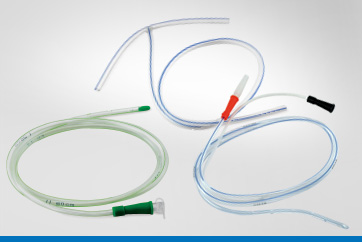 Sterimed High-Performance Gastroenterology Disposables Manufacturing
2. Comprehensive Device Comparison: Salem Sump Tube vs. Levin Tube vs. Enteral Feeding Tubes
For hospital procurement officers, biomedical engineers, and global medical device distributors, understanding the exact functional boundaries between various nasogastric devices is crucial for inventory rationalization, regulatory compliance, and patient safety. The table below outlines the definitive architectural and clinical distinctions between the major categories of gastric tubes.
| Design Vector / Specification | Salem Sump Tube (Sterimed) | Levin Tube | Enteral Feeding Tube (Dobhoff) |
|---|---|---|---|
| Lumen Configuration | Dual-Lumen (Primary Suction + Secondary Air Vent) | Single-Lumen (Combined Suction/Lavage) | Single-Lumen (Ultra-thin wall, Weighted tip) |
| Suction Compatibility | Continuous Suction (Up to -120 mmHg safely) | Low Intermittent Suction Only (-30 to -80 mmHg) | Unsuitable for Suction (Infusion Only) |
| Mucosal Trauma Risk | Near Zero (Prevented by atmospheric air vent) | High (Vacuum fixation against gastric mucosa) | Not Applicable |
| Primary Materials | Thermo-sensitive DEHP-Free Medical PVC / Silicone | Standard Medical PVC / Polyurethane | Polyurethane (PU) / Platinum Silicone |
| Radiopaque Marker | Full-length continuous Barium Sulfate radiopaque line | Intermittent radiopaque line or clear tubing | Encapsulated tungsten weight / Full radiopaque line |
| Anti-Reflux Mechanism | Integrated hydrophobic anti-reflux filter cap (Blue) | None (Requires manual clamping) | Flow-check valve connectors |
| Typical Clinical Placement | ICU, Surgical Wards, ER, Post-Op Gastro Decompression | General Wards, Short-term gastric sampling | Long-term Enteral Nutrition (NJ/NG feeding) |
Information Gain Key Insight for Procurement Directors:
While single-lumen Levin tubes carry a lower unit manufacturing cost, their clinical utilization under continuous suction leads to significantly higher rates of gastric mucosal erosion, tube clogging, and extended nursing care hours. B2B hospital tenders increasingly mandate Salem Sump dual-lumen technology with anti-reflux valves for all adult intensive care and post-surgical departments to lower overall healthcare delivery costs and mitigate clinical risk.
3. Sterimed Salem Sump Tube: Product Recommendations & Technical Anatomy
Sterimed Group manufactures premium-grade Salem Sump Tubes designed to withstand prolonged exposure to acidic gastric juices (pH 1.5–3.5) while maintaining structural lumen integrity, flexibility, and patient comfort. Our manufacturing facilities utilize high-precision extrusion machinery operating within ISO Class 7 and Class 8 cleanrooms.
Key Engineering Highlights & Anatomic Design Considerations
- Thermo-Sensitive Medical PVC: The tube maintains ideal stiffness during nasal insertion to prevent coiling or kink-induced failure, yet rapidly softens at normal body temperature (37°C) to conform smoothly to the nasopharyngeal and esophageal anatomy.
- Heat-Polished Smooth Eyelets: Lateral drainage eyes are punched and thermally smoothed using advanced high-frequency flame-polishing techniques. This ensures 100% burr-free edges, completely eliminating mucosal abrasion during placement and withdrawal.
- X-Ray Sentinel Line: Co-extruded with a dense, highly concentrated Barium Sulfate (BaSO4) formulation. The continuous radio-opaque line enables crisp, clear visualization under radiographic imaging to verify anatomical placement prior to initiating high-volume irrigation or continuous suction.
- Color-Coded Funnel Connectors: Molded with standardized ISO 594 / ISO 80369 color identifiers allowing instant visual identification of French sizing by clinical staff. Connectors fit securely onto standard suction tubing, catheter-tip syringes, and wall suction ports without vacuum leaks.
- Removable Blue Vent Cap & Anti-Reflux Filter: Features a specialized hydrophobic membrane cap that allows atmospheric air to enter the secondary lumen while effectively repelling gastric fluid backflow, maintaining a clean and hygienic patient environment.
Standard Commercial Sizing Chart & Packaging Matrix
Length: 45 cm – 90 cm
Distal Eyes: 2 to 4 smooth eyes
Primary App: Neonatal & paediatric gastric decompression, bile clearance.
Packaging: Individual sterile Tyvek pouch, 50 pcs/inner box.
Length: 105 cm – 120 cm
Distal Eyes: 4 lateral offset eyes
Primary App: General post-operative decompression, fluid lavage, ER trauma.
Packaging: Individual peelable blister pouch, 25 pcs/inner box.
Length: 120 cm
Distal Eyes: 4 to 6 large capacity eyes
Primary App: Heavy gastrointestinal bleeding, acute bowel obstruction, thick particulate lavage.
Packaging: Individual peelable pouch, 25 pcs/inner box.
4. Future Procurement & Industry Trends in Gastrointestinal Disposables (2025–2030)
As global healthcare systems shift toward value-based procurement, sustainability mandates, and stringent regulatory controls, the manufacturing and purchasing landscape for Salem Sump Tubes is undergoing rapid evolution. Key strategic insights for international buyers include:
1. The Global Elimination of Phthalates (DEHP) and REACH Compliance
Regulatory authorities including the European Medicines Agency (EMA) under EU MDR 2017/745 and the US FDA are accelerating the phase-out of Di(2-ethylhexyl)phthalate (DEHP) plasticizers in medical devices intended for mucosal contact. Phthalate leaching under acidic stomach conditions presents long-term endocrine disruption risks. Sterimed has pioneered the transition to alternative, bio-compatible plasticizers such as TOTM (Trioctyl Trimellitate) and DINCH (Hexamoll®), ensuring our Salem Sump Tubes meet non-toxic, DEHP-free mandates across Europe, North America, and Japan.
2. Transition to ISO 80369-3 (ENFit®) Safety Small-Bore Connectors
To eliminate lethal misconnections between gastrointestinal catheters, IV lines, and airway tubes, global standards bodies are enforcing the ISO 80369 series. Future gastroenterology tenders increasingly specify ENFit® compatible or lockable enteral connections for lavage and irrigation ports on Salem Sump assemblies. Forward-looking procurement teams are transitioning inventory to dual-standard adaptors to prevent clinical cross-connection errors.
3. Supply Chain Resilience & India as the Preferred Global MedTech Hub
Over-reliance on single-source East Asian supply chains has created significant vulnerabilities during global logistical shocks. Tier-1 medical distributors in the EU, Americas, and Middle East are actively diversifying procurement toward established Indian manufacturers. India's robust polymer engineering expertise, competitive cost structures, WHO-GMP certified facilities, and strong English-speaking export administration make companies like Sterimed Group the strategic partner of choice for contract manufacturing and long-term supply stability.
4. Integration of Smart Anti-Reflux Hydrophobic Barriers
Legacy Salem Sump catheters required manual positioning of the blue vent above patient stomach levels, failing frequently when patients turned in bed and resulting in gastric fluid leaking onto bedding. Next-generation Salem Sump designs incorporate integrated hydrophobic self-sealing microporous filters within the vent housing. These filters automatically seal upon liquid contact while allowing continuous air ingress when dry, enhancing infection control and reducing hospital-acquired cross-contamination.
5. Frequently Asked Questions (FAQ) for Global Buyers & Clinical Teams
Addressing the top technical, regulatory, and commercial queries queried by healthcare professionals and procurement officers globally.
A Salem Sump Tube features a dual-lumen design specifically built for continuous gastric suction and intestinal decompression. The primary larger lumen evacuates gastric contents, while the secondary smaller lumen acts as an atmospheric air vent. This vent equalizes vacuum pressure at the distal tip, preventing the suction eyelets from adhering to or damaging the gastric mucosa. In contrast, a Levin Tube is a single-lumen tube intended only for low intermittent suction or short-term feeding; continuous suction on a Levin tube can cause severe tissue trauma and blockages.
Because the atmospheric air vent continuously breaks the vacuum lock against the stomach wall, Salem Sump Tubes can safely operate under continuous low-to-medium suction, typically recommended between 30 mmHg and 120 mmHg. Suction pressures exceeding 120 mmHg are generally avoided as they can overcome the venting capability and increase the risk of tissue irritation or fluid backflow through the vent lumen.
The secondary vent lumen connector is colored blue to provide immediate visual identification for nursing staff, ensuring it is never accidentally connected to suction machines, IV lines, or enteral feeding bags. To maintain proper operation, the blue vent must remain open to room air and elevated above the level of the patient's stomach. If gastric fluid begins leaking out of the vent, the main lumen should be flushed with sterile saline and air injected through the blue vent to re-establish the air lumen buffer.
Yes. Sterimed manufactures Salem Sump Tubes using medical-grade thermo-sensitive PVC formulated completely DEHP-free (or phthalate-free upon client specification). Our manufacturing facilities operate under stringent ISO 13485 quality management systems, and technical documentation complies fully with EU MDR 2017/745, CE mark criteria, and ISO 10993 biocompatibility standards for prolonged mucosal contact.
Sterimed Group provides turnkey OEM and private label solutions for international healthcare distributors. Options include custom-printed medical Tyvek/film pouches, private-label shelf packaging, multilingual IFUs (Instructions for Use) in over 15 languages, custom outer export shippers, specialized tube lengths, and custom color-coded connectors tailored to specific market regulations.
Our single-use gastroenterology catheters undergo validated 100% Ethylene Oxide (EO) terminal sterilization in accordance with ISO 11135 principles. Every batch is subjected to rigorous biological indicator testing and EO residual aeration analysis, ensuring residuals fall well below ISO limits. The product carries a validated sterile shelf life of 5 years when stored in its original unopened peel-pouch packaging under cool, dry conditions.
During our precision co-extrusion process, a concentrated continuous line of medical-grade Barium Sulfate (BaSO4) is embedded directly into the PVC tube wall. This radio-opaque line runs seamlessly from the distal tip up to the proximal connector, guaranteeing high-contrast visibility under bedside X-ray fluoroscopy to confirm proper positioning above or within the antrum.
6. Enterprise Strengths: Why Global Healthcare Procurement Trusts Sterimed Group
Founded in 1955, Sterimed Group has established itself as one of the world's premier manufacturers and exporters of medical disposables, surgical products, and high-purity polymer tubing. With over 65 years of engineering heritage, our operations combine deep technological expertise with uncompromising quality assurance.
State-of-the-Art Cleanroom Manufacturing
Extrusion, thermal eye-polishing, printing, assembly, and primary pouch sealing are executed inside automated, environmentally controlled ISO Class 7 and Class 8 cleanrooms under WHO-GMP compliance.
Unrivaled Quality & Regulatory Dossiers
Sterimed holds comprehensive quality accreditation including ISO 9001, ISO 13485, CE marking, and WHO-GMP certifications. Full device master files (DMF), biocompatibility reports (ISO 10993), and clinical evaluation reports are readily accessible for distributor registration.
100% Batch Traceability
Every individual unit pouch and outer carton carries explicit lot tracking numbers, manufacturing timestamps, sterilization indicator dots, and standard GS1 barcodes, ensuring complete transparency across the supply chain.
Export Footprint in 90+ Nations
With long-standing distributor partnerships across Europe, North America, Latin America, Africa, the Middle East, and Asia-Pacific, our logistics desk manages international customs clearances, container loading, and multimodal freight smoothly.
Ready to Source High-Quality Salem Sump Tubes Factory-Direct?
Contact our dedicated international trade department for sample requests, competitive wholesale pricing, and OEM technical dossiers.
Domestic: [email protected] | International: [email protected] | Tel: +91-11-48880000